
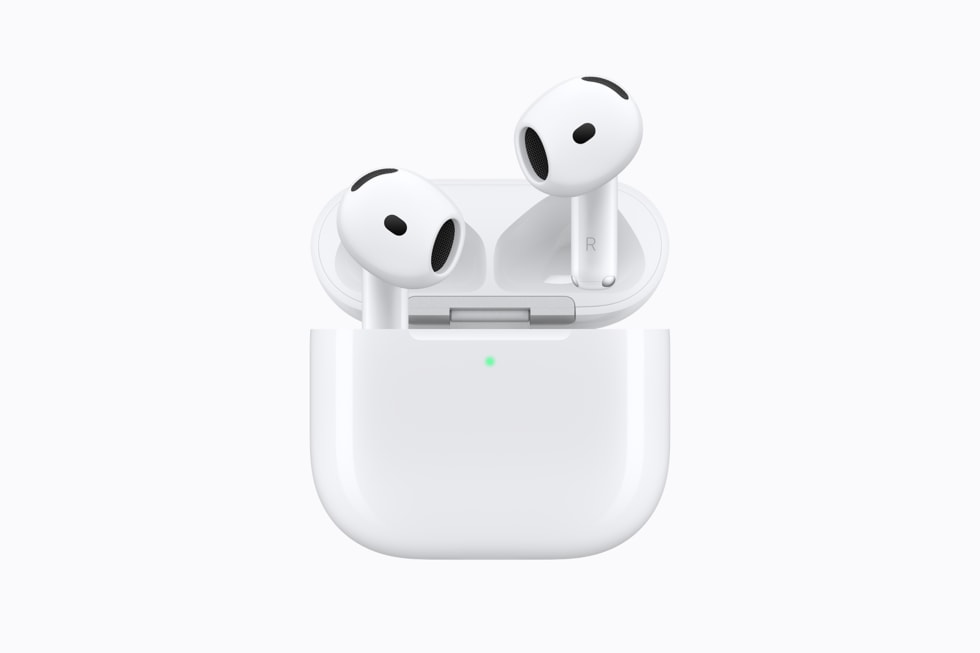
Apple's AirPods 5 are now available in Canada in two versions. The regular model costs $179 CAD, while AirPods 5 with Wireless Charging Case cost $209 CAD. Both include Active Noise Cancellation, Adaptive Audio, Transparency mode and the H2 chip. The extra $30 pays for longer battery life, wireless case charging, a Find My case speaker and volume control on the earbud stem.
Apple announced AirPods 5 on September 9, 2026, and released them in Canadian stores on September 18. They use the familiar open-ear shape rather than silicone ear tips, placing them below AirPods Pro in Apple's earbud range.
AirPods 5 specifications at a glance
| Feature | AirPods 5 | AirPods 5 with Wireless Charging Case |
|---|---|---|
| Canadian price | $179 CAD | $209 CAD |
| Active Noise Cancellation | Yes | Yes |
| Battery with ANC | Up to 4 hours | Up to 5 hours |
| Battery with ANC and case | Up to 20 hours | Up to 22 hours |
| Battery with noise control off | Up to 6 hours | Up to 7 hours |
| Case charging | USB-C | USB-C, Qi or Apple Watch charger |
| Find My case speaker | No | Yes |
| On-stem volume swipe | No | Yes |
| Dust, sweat and water resistance | IP57 | IP57 |
| Wireless connection | Bluetooth 5.3 | Bluetooth 5.3 |
Apple does not include a USB-C charging cable or power adapter in the box. Buyers moving from an older Lightning-based AirPods model may need to use an existing USB-C cable or purchase one separately.
What is different between the two models?
The earbuds share the same core audio system. Both have Apple's H2 headphone chip, the same open-ear design, Active Noise Cancellation, Adaptive EQ, Adaptive Audio, Conversation Awareness, Voice Isolation and Personalized Spatial Audio. Buying the more expensive model does not provide stronger noise cancellation or a different speaker driver.
The practical differences are battery, controls and the case. The $209 version lasts up to one hour longer per charge, depending on the listening mode. It also lets the wearer swipe up or down on a stem to change the volume. On the $179 model, playback and listening modes can be controlled from the stem, but volume must be changed with the connected device or Siri.
The wireless case can charge on a Qi pad, an Apple Watch charger or over USB-C. Its built-in speaker can play a sound through Find My, which may make a misplaced case easier to locate. The standard case charges only through USB-C and has no speaker.
For people who expect to keep the earbuds for several years, the $30 difference is relatively small compared with the convenience of wireless charging and direct volume adjustment. The standard version provides the same listening features at the lowest price.
Active Noise Cancellation in an open-ear design
Most noise-cancelling earbuds use silicone tips to form a physical seal in the ear canal. AirPods 5 remain open-ear earbuds, so they rest in the ear without that seal. This can feel less enclosed and makes them easier for some people to wear for long periods, but fit varies by ear shape.
Apple says AirPods 5 remove up to 50 percent more external noise than AirPods 4 with Active Noise Cancellation. That comparison is based on Apple's testing under controlled conditions. The amount of reduction in normal use depends on fit, the type of background sound, settings and the surrounding environment.
The H2 chip and microphones monitor outside sound and produce an opposing signal to reduce it. Continuous low-frequency sounds, such as an aircraft cabin or transit rumble, are generally more suitable for cancellation than abrupt nearby voices or sharp sounds. An open-ear design also does not isolate sound in the same way as a properly fitted sealed earbud.
Transparency mode does the reverse by passing outside sound through the microphones. Adaptive Audio automatically blends Transparency and noise cancellation according to the environment. Conversation Awareness lowers media volume when the wearer begins speaking, then restores it after the conversation.
Sound and Spatial Audio
AirPods 5 use a new multiport acoustic architecture, a custom high-excursion driver and Adaptive EQ. The inward-facing microphone measures what the listener hears, while Adaptive EQ adjusts frequencies to account for fit and ear geometry.
Personalized Spatial Audio can create a sound profile using an iPhone with a TrueDepth camera. Dynamic head tracking can then keep compatible movie, television and music audio positioned relative to the screen or virtual sound field. It requires supported content and apps, and the personalized feature is not available when the earbuds are used only as generic Bluetooth headphones.
The earbuds also support studio-quality audio recording in compatible Apple software and Voice Isolation for calls. Voice Isolation uses processing to reduce background noise around the speaker. Results still depend on wind, microphone position, network quality and the calling app.
Battery life and charging
The regular AirPods 5 are rated for up to four hours of listening with ANC enabled or six hours with noise control off. The case raises the ANC total to as much as 20 hours. Five minutes in the case provides about one hour of listening under Apple's test conditions.
AirPods 5 with Wireless Charging Case are rated for up to five hours with ANC or seven hours with noise control off. The case extends ANC listening to a maximum of 22 hours. Both versions use rechargeable batteries that gradually lose capacity through normal charge cycles and age.
Battery figures are maximum estimates, not a guaranteed result. Volume, calls, Siri use, spatial audio, temperature, settings and battery condition affect operating time. The earbuds pause audio when their optical sensors detect that they have been removed, which can reduce unnecessary playback.
Siri AI and head gestures
AirPods 5 can provide hands-free access to Siri AI through a compatible iPhone. Apple's updated assistant can hold longer conversations, use broad knowledge and draw on personal context from supported messages, email, photos and apps when the required permissions are enabled.
The earbuds do not run the AI model themselves. Siri AI requires an Apple Intelligence-compatible device, supported software and language, and some requests use an internet connection or Apple's server-side models. Apple describes the feature as a beta and says some server-based functions are subject to usage limits.
Head gestures allow a wearer to nod or gently shake their head to answer certain Siri prompts, such as whether to accept a call or hear a notification. Regular commands can still be started by saying "Siri" or "Hey Siri." Our guides to iPhones that support Apple Intelligence and Apple's new Siri AI explain the phone requirements in more detail.
Live Translation requirements
Live Translation can play a translated version of an in-person conversation through the AirPods. It is set up in Apple's Translate app, where the required languages can be downloaded. A session can then be started by pressing both stems, asking Siri or using the iPhone's Action button on supported models.
This feature depends on a compatible Apple Intelligence device with the latest operating system, current AirPods firmware and Apple Intelligence turned on. Language and regional availability are limited. Apple currently lists supported variants rather than every regional form of a language, so Canadian users should check Apple's feature-availability page if a specific French, English or other language configuration is required.
Live Translation is an aid for everyday conversation, not a certified interpreter. Accuracy can change with accents, background noise, specialized terminology and overlapping speech. Legal, medical or safety-critical conversations may still require a qualified human interpreter.
Compatibility with iPhone, Android and other devices
For full functionality, Apple lists iPhone, iPad, Apple Watch, Mac, Apple TV and Apple Vision Pro models running their latest operating systems. Once paired to an Apple Account, AirPods can move between supported Apple devices associated with that account. The exact intelligent features available depend on the connected hardware and software.
AirPods 5 also work as standard Bluetooth headphones with Android phones, Windows computers and other non-Apple devices. Apple says users can listen and talk, but functionality is limited. Siri, automatic Apple Account pairing, Personalized Spatial Audio profiles and Apple-specific setup screens are not available in the same way.
To pair AirPods 5 with a non-Apple device, open the case with the earbuds inside and double-tap the front until the status light flashes white. Select AirPods from the other device's Bluetooth menu. Basic playback and call quality can also vary by the Bluetooth implementation and supported audio codecs on that device.
Water and dust resistance
Both the earbuds and charging cases carry an IP57 rating. The first digit indicates a high level of dust protection, while the second means the product passed a temporary immersion test under controlled laboratory conditions. The rating is intended for non-water sports and exercise.
IP57 does not make AirPods waterproof. Apple says resistance can decrease with normal wear, and wet earbuds should not be charged. They should not be used while swimming or intentionally submerged. Soap, lotion, salt water and other liquids can also affect materials and seals differently from fresh-water laboratory testing.
Which AirPods 5 should you buy?
The $179 AirPods 5 are the value option. They provide the same audio hardware, ANC, Transparency mode and intelligent features as the more expensive version. They are suitable for buyers who normally charge by cable and do not need a volume gesture on the stem.
The $209 model is easier to recommend for frequent use. Its extra hour of advertised listening time, wireless charging, Find My case speaker and on-stem volume control are useful daily additions. None is essential, but the $30 premium is clear and easy to compare.
Buyers who need the strongest passive isolation should also compare AirPods Pro, since silicone tips create a seal that an open-ear AirPod does not. People who cannot comfortably wear sealed earbuds may prefer the AirPods 5 shape. Trying the fit is useful because Apple does not provide alternate ear-tip sizes for this design.
Sources
- Apple Canada: AirPods 5 announcement
- Apple Canada: AirPods 5 technical specifications
- Apple Support: pair AirPods with a non-Apple device
Prices, specifications and feature availability are current as of October 18, 2026.