
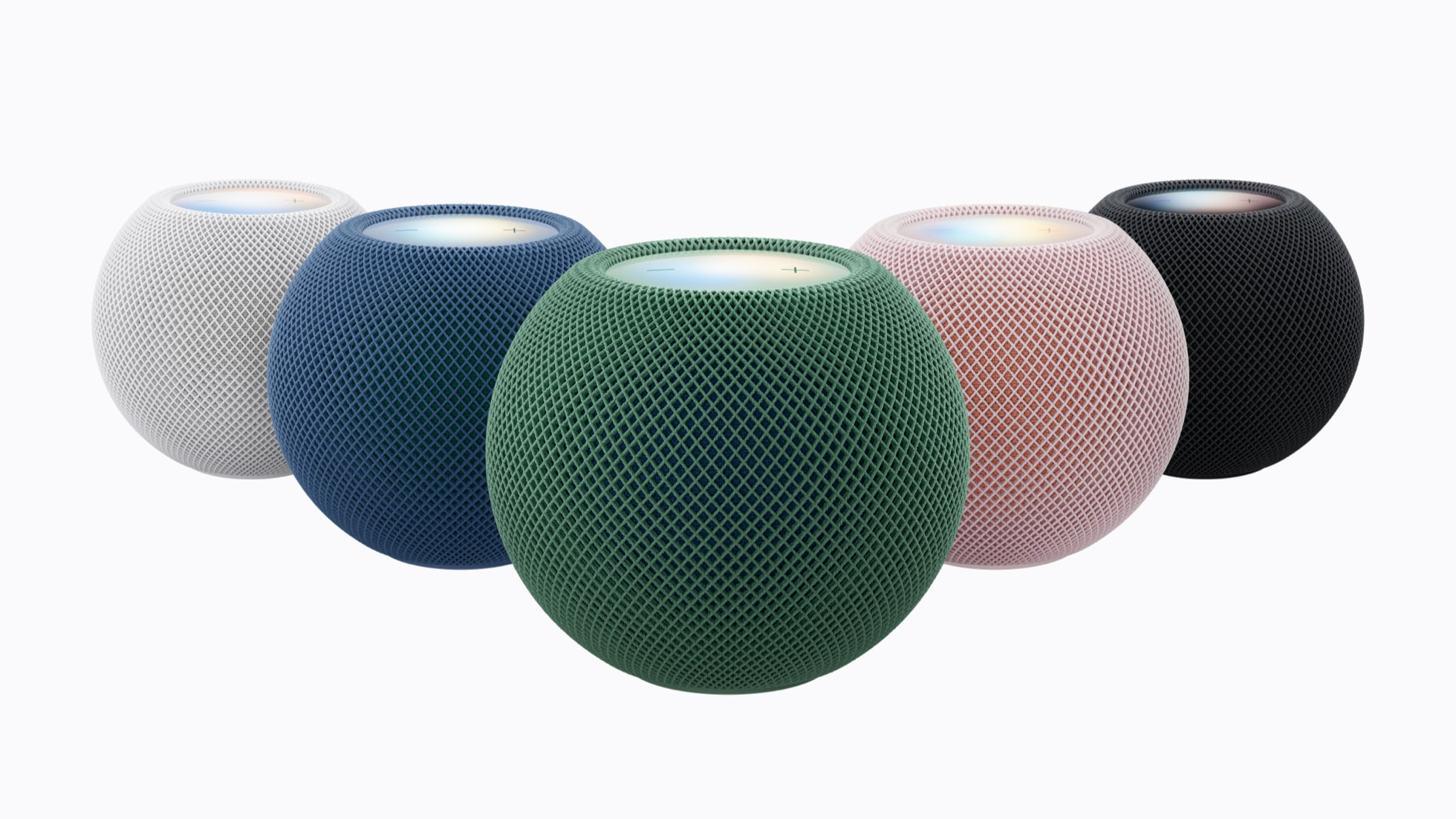
Apple's HomePod mini 2 will be released in Canada on October 30, 2026, for $199 CAD. The second-generation compact smart speaker adds an S10 chip, Siri AI support through a future software update, Wi-Fi 6E, Bluetooth 6, a music-reactive top surface called Sound Glow and expanded audio options with newer Apple devices.
Pre-orders opened on October 13 through Apple Store Canada and the Apple Store app. Five colours are available: pink, green, blue, white and midnight. The speaker includes a 20W power adapter in the box.
HomePod mini 2 specifications
| Feature | HomePod mini 2 |
|---|---|
| Canadian price | $199 CAD before tax |
| Canadian release date | October 30, 2026 |
| Processor | Apple S10 |
| Speaker system | Full-range driver and two passive radiators |
| Microphones | Three-microphone far-field array |
| Wireless | Wi-Fi 6E, Bluetooth 6, Thread and Ultra Wideband |
| Smart assistant | Siri; Siri AI through a future update |
| Smart-home functions | Home hub, Matter and Thread support, automations |
| Sensors | Temperature and humidity |
| Size | 84.3 mm high by 97.9 mm wide |
| Weight | 335 g |
| Colours | Pink, green, blue, white and midnight |
| Power | Included 20W adapter |
Apple lists an iPhone or iPad running the latest operating system and Wi-Fi internet access as the basic setup requirements. A Mac cannot complete the initial HomePod setup by itself.
Canadian price and availability
HomePod mini 2 costs $199 in Canada. That is $20 more than the $179 price at which Apple listed the original HomePod mini before the new model arrived. The full-size second-generation HomePod remains available for $479.
The new mini can be pre-ordered now and is scheduled to reach Apple Stores on Friday, October 30. Availability at other Canadian retailers may vary. The price does not include provincial sales tax, AppleCare or an Apple Music subscription.
What changed from the original HomePod mini?
The exterior remains close to the compact spherical design introduced in 2020, but the internal platform is substantially newer. HomePod mini 2 replaces the original model's S5 chip with Apple's S10 chip. Apple uses the extra processing capacity for real-time audio tuning, Siri AI and newer connected-home functions.
Wireless hardware has also moved forward. The original mini used 802.11n Wi-Fi and Bluetooth 5.0; Apple lists Wi-Fi 6E and Bluetooth 6 for the new version. Thread networking and an Ultra Wideband chip remain part of the design. Actual Wi-Fi performance depends on the home network, and a Wi-Fi 6E router is not required simply to play audio.
The new Sound Glow surface can pulse and change colour in response to a song's bass, treble and album artwork. It is a visual feature rather than a display: the top still uses touch controls for playback, volume and Siri, and it does not show text or video.
The five-colour range drops the first model's yellow and orange finishes. Pink and green join updated blue, white and midnight options.
Audio hardware and everyday listening
HomePod mini 2 has one full-range driver and two force-cancelling passive radiators. A custom waveguide distributes sound around the speaker, while the S10 chip analyzes audio and adjusts its output in real time. This is still a small speaker, so buyers should not expect the low-frequency output or maximum volume of the larger $479 HomePod.
One speaker can play in a room on its own. Two matching HomePod mini 2 units can be configured as a left-right stereo pair, and several HomePod speakers can play together through AirPlay multiroom audio. A stereo pair represents a $398 hardware purchase before tax.
Supported sources include Apple Music, Apple Podcasts, iTunes purchases, iCloud Music Library, internet radio and participating third-party music services. Audio from an iPhone, iPad, Mac or Apple TV can also be sent to the speaker using AirPlay. Some services may require their own subscription or may not support every Siri command.
The three-microphone array is designed to hear Siri commands from across a room. Microphone performance can still be affected by loud playback, room acoustics and distance. Touching the top provides manual play, pause, track, volume and Siri controls when voice control is not convenient.
Siri AI is coming later
Siri AI is one of the main additions, but it will not be available when the speaker first goes on sale. Apple says English support will come to HomePod mini 2 in Canada through a future free software update. The company has not provided an exact release date.
The updated assistant is designed for more conversational follow-up questions, broader web knowledge, improved music discovery and requests that use personal context. For example, a user may ask it to find a song mentioned in a message, locate a recipe from email or create a reminder connected to a calendar event.
Personal-context requests require the Home owner to have an Apple Intelligence-compatible iPhone or iPad running current software, with Siri AI enabled in a supported language. HomePod can recognize up to six household users by voice and connect a request to the appropriate person's device when the feature and permissions are configured.
Once Siri AI has been enabled for the home, household members without their own Apple Intelligence device can still use general knowledge, conversational responses and improved music discovery. Some server-based Apple Intelligence functions are subject to usage limits. Our guides explain which iPhones support Apple Intelligence and what Apple's new Siri AI does.
Sound Glow and music controls
Sound Glow turns the illuminated top into a colour effect synchronized with music. Colours can be drawn from the current album artwork, and ambient soundscapes such as rain have their own animations. Voice control of Sound Glow requires an Apple Intelligence-enabled iPhone with current software.
The lighting can make playback status easier to see, but it is not a general notification screen. The top still provides touch controls for playback, volume and Siri.
Apple TV surround sound has strict requirements
HomePod mini 2 can be part of a four-speaker surround setup with the fourth-generation Apple TV 4K. Apple says the system detects speaker positions and calibrates timing and levels for the room.
This setup requires four compatible HomePod speakers arranged as matching front and rear pairs, plus an Apple TV 4K (4th generation) on current software. Apple permits HomePod mini 2 or second-generation full-size HomePods in the matching pairs. It is not the same as buying one or two mini speakers and adding them to any older Apple TV.
Four HomePod mini 2 speakers cost $796 before tax, excluding the Apple TV. The speaker can also serve as Mac audio for music, video and calls. Apple limits this newer Mac speaker mode to Macs with Wi-Fi 6E or later, using either one HomePod or a stereo pair. There is no analog or USB audio input.
Smart-home hub, Thread and sensors
HomePod mini 2 works as a home hub in Apple's Home app. It can run automations, provide remote access to compatible accessories and connect Thread-based smart-home devices. Thread is a low-power mesh networking system used by some Matter and HomeKit products; the speaker does not make every smart accessory compatible automatically.
The built-in temperature and humidity sensor can report room conditions and trigger automations. Placement near a window, heating vent or appliance may affect readings, so the speaker should be positioned where it can reasonably sample the room.
Sound Recognition can listen for smoke and carbon monoxide alarm sounds and send a notification to an iPhone, iPad or Apple Watch. Apple states that this feature should not be relied on in emergencies or situations where missed detection could cause harm. It supplements a certified alarm and does not replace one.
The speaker will also work with Apple's coming Home Collection cameras and doorbells. Face announcements require HomeKit Secure Video with Face Recognition enabled. Those accessories are separate products, and Apple says the collection will begin arriving in stages from December 2026 into early 2027.
Setup and compatibility
Initial setup requires an iPhone or iPad on the latest iOS or iPadOS. The phone or tablet transfers its Apple Account, Wi-Fi and Home settings after it is held near the powered speaker. Bluetooth and two-factor authentication should be enabled, and Apple recommends using the same Wi-Fi network that will serve the HomePod.
Android phones cannot perform the normal HomePod setup and do not receive an equivalent Apple Home app. The speaker is therefore best suited to households already using an iPhone or iPad. It is also more restrictive than a general Bluetooth speaker: Apple lists Bluetooth for its internal wireless functions, but HomePod audio is centred on AirPlay and supported services rather than ordinary Bluetooth pairing from any phone.
Privacy and household use
Apple says Siri requests can be processed on the device or through Private Cloud Compute. Personal requests depend on the settings and permissions on the linked iPhone or iPad. People sharing a home should review voice recognition, personal requests, purchase controls and access to Home accessories before placing the speaker in a common area.
Who should consider HomePod mini 2?
HomePod mini 2 is most suitable for an Apple household that wants a compact music speaker, Siri access and a Home hub in one device. It offers a newer wireless platform and clearer future support than buying the discontinued first-generation model, while remaining far less expensive than the full-size HomePod.
Existing original HomePod mini owners do not need to replace every speaker for basic AirPlay, multiroom audio, sensors or common Home functions. The stronger reasons to upgrade are Siri AI support, Sound Glow, newer Wi-Fi and Bluetooth hardware, Mac speaker support on compatible models and the new four-speaker Apple TV arrangement.
Anyone mainly using Android, Spotify Connect, a wired audio source or a mixed smart-home platform should compare alternatives carefully. The HomePod mini 2 provides its fullest feature set inside Apple's hardware and services.
Sources
- Apple Canada: HomePod mini 2 announcement
- Apple Canada: HomePod mini 2 technical specifications
- Apple Support: set up HomePod or HomePod mini
Prices, specifications and availability are current as of October 24, 2026.