
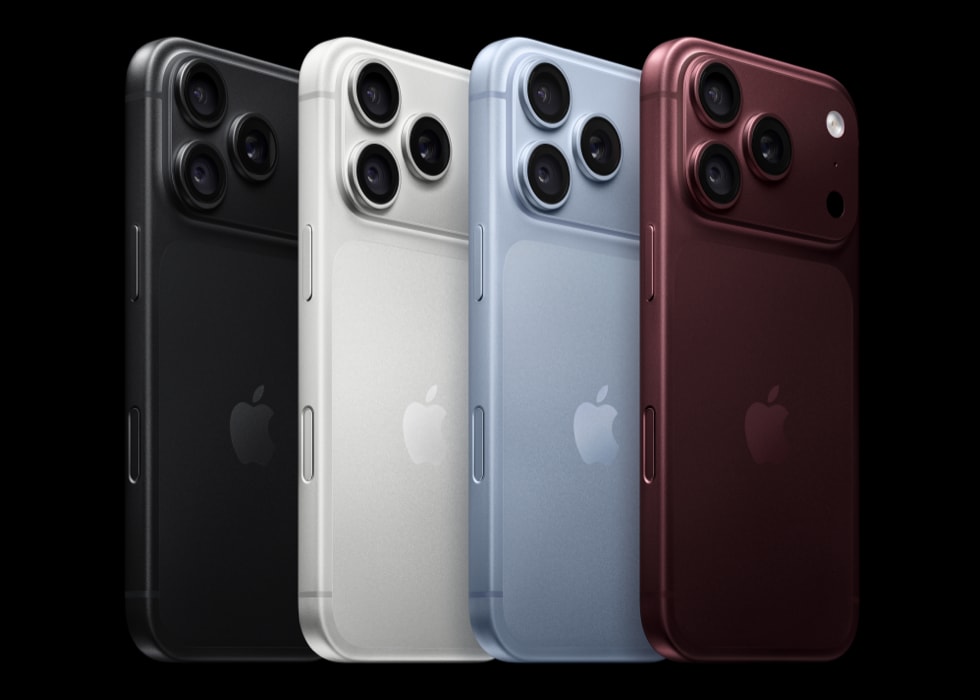
Apple's iPhone 18 Pro and iPhone 18 Pro Max are now available in Canada. Both models introduce the A20 Pro chip, a variable-aperture main camera, longer advertised battery life and the Siri AI features included with iOS 27.
The two phones have nearly identical core specifications. The main reasons to choose the Pro Max are its larger 6.9-inch display and longer battery estimates. The regular Pro provides the same processors and camera system in a smaller, lighter phone and costs $150 less at every storage level.
iPhone 18 Pro Canadian prices
Apple sells both models with 256GB, 512GB, 1TB or 2TB of storage. Canadian prices before tax are:
| Storage | iPhone 18 Pro | iPhone 18 Pro Max |
|---|---|---|
| 256GB | $1,749 | $1,899 |
| 512GB | $2,049 | $2,199 |
| 1TB | $2,649 | $2,799 |
| 2TB | $3,549 | $3,699 |
The 256GB iPhone 18 Pro starts at $72.87 per month over 24 months through Apple's Canadian financing offer, while the Pro Max starts at $79.12 per month. Taxes, eligibility and terms apply. Apple's advertised trade-in credit of up to $1,415 for an iPhone 13 or newer is a maximum; the actual value depends on the model, storage, condition and inspection result.
iPhone 18 Pro versus Pro Max specifications
| Feature | iPhone 18 Pro | iPhone 18 Pro Max |
|---|---|---|
| Display | 6.3-inch OLED | 6.9-inch OLED |
| Resolution | 2622 by 1206 | 2868 by 1320 |
| Refresh rate | Up to 120Hz ProMotion | Up to 120Hz ProMotion |
| Dimensions | 150.0 x 71.9 x 8.75 mm | 163.4 x 78.0 x 8.75 mm |
| Weight | 211 g | 249 g |
| Chip | A20 Pro | A20 Pro |
| Rear cameras | 48MP main, 48MP ultra wide, 48MP telephoto | Same |
| Apple video playback estimate | Up to 36 hours | Up to 45 hours |
| Storage | 256GB to 2TB | 256GB to 2TB |
| SIM in Canada | Dual eSIM; no physical SIM tray | Dual eSIM; no physical SIM tray |
| Starting price | $1,749 | $1,899 |
Both are available in black, silver, glacier and burgundy. They also share an IP68 water- and dust-resistance rating, although water damage is not covered as a normal warranty claim. Our iPhone water-resistance guide explains what Apple's IP ratings do and do not cover.
Size and display differences
The iPhone 18 Pro has a 6.3-inch display and weighs 211 grams. The Pro Max increases the display to 6.9 inches and the weight to 249 grams. Both are 8.75 mm thick, but the Pro Max is taller and wider.
The larger model provides more room for video, games, documents and the on-screen keyboard. The regular Pro is easier to use one-handed. Because the processors and rear cameras are the same, selecting it does not reduce performance or zoom capability.
Both OLED displays include an Always-On mode, ProMotion with adaptive refresh rates up to 120Hz and an outdoor peak brightness rating of 3,000 nits. The Dynamic Island is smaller than on the previous generation and can display as many as three Live Activities at once.
Variable-aperture camera explained
The main camera is the most notable hardware change. It uses a 48-megapixel sensor and a physical six-blade aperture with four available settings: f/1.48, f/1.8, f/2.8 and f/4.
An aperture controls how much light enters the camera and influences how much of a scene appears in focus. A wider setting such as f/1.48 admits more light, which can help in dim conditions and can produce shallower depth of field. A narrower setting such as f/4 keeps more of the foreground and background in focus, which can be useful for group photos or landscapes.
The phone can select an aperture automatically. Apple's new Pro controls also permit manual adjustment of aperture, shutter speed and white balance, with a histogram available to help judge exposure. Those controls provide more flexibility, but the automatic Camera mode remains available for ordinary photos.
The other rear cameras are a 48MP ultra wide and a 48MP telephoto. Apple lists 4x optical zoom and up to 8x optical-quality zoom, with digital zoom extending to 40x. The front camera is an 18MP Center Stage camera that can adjust framing and orientation for photos and video calls.
Photo authenticity and video features
Reference mode can record signed sensor data alongside a photo. Private Cloud Compute develops it into an Apple Reference Image, which can be viewed beside the main picture to help show what the sensor captured before edits. This is an optional mode.
For video, both models support up to 4K Dolby Vision at 120 frames per second on the main camera. ProRes, ProRes RAW, Apple Log 2 and genlock are available for production workflows. USB-C supports USB 3 transfer speeds up to 10Gb/s with an appropriate cable, which is useful when recording large video files to external storage.
Users who do not work with professional video formats should consider their storage requirements before paying for 1TB or 2TB. HEIF photos and standard HEVC video require much less space than ProRes footage.
A20 Pro performance and cooling
Both phones use the same A20 Pro system on a chip. It contains a six-core CPU, seven-core GPU and two 16-core Neural Engines. Apple says the chip has 50 percent more memory bandwidth than A19 Pro and that its GPU is up to 40 percent faster, although those comparisons are based on Apple's testing and will vary by task.
The internal layout connects the chip directly to a next-generation vapour chamber. It spreads heat across a larger area to help maintain performance during games, video processing and other sustained workloads. Real-world performance depends on temperature, software and battery conditions.
Wireless hardware includes Wi-Fi 7, Bluetooth 6, Thread and Apple's second-generation Ultra Wideband chip. The C2 cellular modem replaces the previous generation and is designed to improve cellular efficiency and uploads. Network performance will still depend on the carrier, plan, frequency bands, congestion and local coverage.
Battery life and charging
Apple rates the iPhone 18 Pro for up to 36 hours of local video playback and 33 hours of streamed video. The Pro Max is rated for up to 45 and 40 hours respectively, plus up to 30 hours under Apple's broader usage model.
These are controlled Apple estimates rather than guarantees for a normal day. Screen brightness, cellular signal, navigation, camera use, gaming and background activity can substantially change the result. The relative difference is still useful: the Pro Max is designed for longer operation between charges.
With a compatible 60W or higher AVS power adapter, Apple says either model can reach approximately 50 percent charge in 15 minutes. MagSafe can provide up to 25W and reach about 50 percent in 30 minutes when paired with a suitable 35W or higher adapter. Charging slows as the battery fills and when temperature management is required. A power adapter is sold separately.
eSIM-only models in Canada
Canadian iPhone 18 Pro models do not have a physical SIM tray. They can store eight or more eSIMs and keep two lines active simultaneously. Apple specifically lists Bell, Freedom Mobile, Rogers and Telus among the supported Canadian eSIM carriers. Their associated brands and smaller providers may have different activation processes, so customers should confirm support before moving a number.
Travellers can add a compatible prepaid travel eSIM without removing their Canadian line. However, an existing physical SIM from a carrier that does not support eSIM cannot simply be inserted into these phones. Anyone using a corporate, foreign or regional provider should verify that the provider can issue an eSIM before buying.
Apple used the space previously occupied by the SIM tray for a larger battery. It attributes two additional hours of video playback to the eSIM-only design.
iOS 27, Apple Intelligence and Siri AI
The phones ship with iOS 27 and support the full current Apple Intelligence feature set. Siri AI launched in beta in English with iOS 27. It can use personal context from supported messages, email and photos, respond to information shown on screen, and answer broader knowledge questions. Siri mode in Camera can also identify or act on information in view.
Apple says eligible processing happens on the device where possible and uses Private Cloud Compute for more complex requests. Feature access can still depend on language, region and the installed iOS version. Our iOS 27 update guide covers the broader software changes, while the Apple Intelligence compatibility guide lists other supported iPhones.
Which model should you buy?
The iPhone 18 Pro is the more practical choice for someone who wants the new camera and processor in a smaller phone. It is 38 grams lighter and saves $150 without reducing camera capability, performance or storage options.
The Pro Max is suited to buyers who regularly use the phone for video, reading, games or navigation and prefer the larger display. Its main functional advantage is battery life. Buyers should handle both sizes where possible, since dimensions and weight can be more noticeable over several years than a specification table suggests.
For storage, 256GB is adequate for many users who stream media and use cloud photo storage. The 512GB tier provides more room for offline media and high-resolution recording. The 1TB and 2TB models are mainly useful for people who keep large local libraries or record substantial amounts of ProRes video. Storage cannot be expanded later.
Canadian availability
Apple announced the phones on September 9, 2026, and released them in Canada on September 18. They are available through Apple and Canadian carriers, with colour, storage and delivery times varying by seller.
Before choosing a carrier promotion, compare the required plan price, financing term, device-return condition and total amount paid. Some offers reduce the monthly phone payment but require the device to be returned or bought out at the end of the term.
Sources
- Apple Canada Newsroom: iPhone 18 Pro and iPhone 18 Pro Max
- Apple Canada: iPhone 18 Pro technical specifications
- Apple Canada: Buy iPhone 18 Pro
Prices, features and availability are current as of September 28, 2026.